134th Infantry Regiment Website
"All Hell Can't Stop Us"

|
|
134th Infantry Regiment Website"All Hell Can't Stop Us" |
|

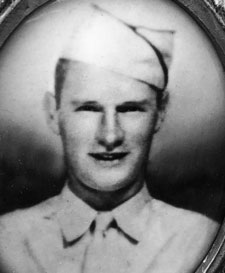
Arthur Robert Hiatt was born April 23, 1920 in the
Piedmont region of Virginia bordering North Carolina. He was the oldest of 5
children born to Lawrence Noel Hiatt and his wife Pearlie Mae. His father was a
farmer living in Dan River, Virginia. Sometime during the 1930's the family
moved about 20 miles east to Fancy Gap, another small Virginia town along the
North Carolina border. He registered for the draft on July 1, 1941 when he was
21 years old, unemployed, and living with his family in Ararat, Virginia. His
draft record lists him as being 5'8" tall, weighing 140 pounds, with blue eyes,
brown hair, and a ruddy complexion. He was inducted into the Army December 17,
1942 at Roanoke, Virginia. At the time he was a Cabinet Maker, single, no
dependents, with a grammar school education.
Private Hiatt was sent
overseas in October 1944 and joined the 320th Infantry Regiment from the 38th
Replacement Battalion on November 13, 1944 as an Anti-Tank Crewman. He was
promoted to Private First Class January 1, 1945 during the Battle of the Bulge
near Baschleiden, Luxembourg and was with the Division throughout the remainder
of the war. V-E Day found the 35th Infantry Division on occupation duty in the
vicinity of Hannover, Germany, where they stayed until May 17 - 18 when they
were relieved and sent to Recklinghausen, Germany before moving by motor and
rail for occupation duties in the Koblenz area of Germany on June 1 - 4, 1945.
PFC Hiatt's unit, Headquarters Company 2nd Battalion, 320th Infantry Regiment,
was stationed at Altenkirchen, Germany, about 35 miles north of Koblenz.
Private First Class Arthur R. Hiatt was killed in action June 25, 1945. Four
other soldiers in PFC Hiatt's unit were wounded that day; PFC William W. Best,
PFC James E. King, PFC Joseph M. Osborn, and
PFC Kenneth J. VanEtten. Their
squad was loading unexploded German artillery shells onto the back of a dump
truck to be disposed of when one fell and there was an explosion. PFC Arthur R.
Hiatt was killed by the blast. He was originally buried June 28, 1945 at the
temporary American Military Cemetery, now the Luxembourg American Military
Cemetery and Memorial, at Hamm, Luxembourg. After the war, families of fallen
service members were sent a questionnaire along with the 1946 Quartermaster
pamphlet, "Tell Me About My Boy", explaining burial options. They could leave
their loved ones abroad in a permanent overseas cemetery maintained in
perpetuity by the American Battle Monuments Commission (ABMC) or have them
returned home at the government's expense for burial in a national or private
cemetery.
Arthur Hiatt's mother, Pearlie May, requested that
her son be returned home for burial. His personal effects were also returned to
her, including a billfold, photographs, a Zippo lighter, wristwatch, fountain
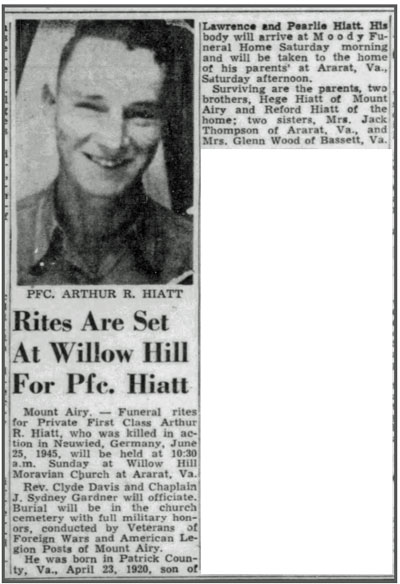
pen, a pair of wooden shoes, and bundle of letters. His body arrived at Moody
Funeral Home in Mount Airy, North Carolina on Saturday, April 9, 1949. From
there it was taken to his parents' home in Ararat, Virginia. Funeral rites with
full military honors were held Sunday, April 10, 1949 at the Willow Hill
Moravian Church in Ararat. Pfc Arthur R. Hiatt, the last 35th Infantry Division
soldier to be killed in WWII, was laid to rest Sunday, April 10, 1949 at Willow
Hill Moravian Church Cemetery.