
134th Infantry Regiment Website
"All Hell Can't Stop Us"

|
|
134th Infantry Regiment Website"All Hell Can't Stop Us" |
|

PERSONAL LIFE
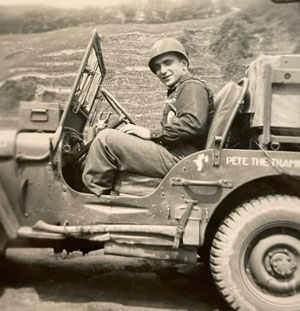
Robert ("Bob") had been valedictorian at his law school. After WWII, he pursued his career as a lawyer, known not only for his sharp intellect, but for his integrity and practical wisdom. In both his practice and his life, he quietly but profoundly touched the lives of many with acts of kindness. Bob's greatest joy was being a devoted husband to a wife who was his perfect match, a nurturing father to two sons, and a loving grandfather. He enchanted children and adults alike with his playful spirit and funny jokes. He and his wife were wonderful hosts, filling their gatherings with dance, laughter, and family traditions. Bob relished active days spent swimming, boating, clamming and fishing with family and friends in his favorite place, East Hampton, NY - never content to sit still when there was fun to be had and new experiences to share with others.
MILITARY DRAFT AND TRAINING
On October 16, 1940, Bob registered with the local
Bronx Draft Board. He was inducted into the Army by letter dated October 24,
1941.
Bob was chosen to train at the selective Officer
Candidate School (OCS). Upon graduation from OCS, he was automatically given the
rank of 2nd Lieutenant. His officer training continued for over a year at
various Army bases around the United States.
His last training role was
as Infantry Company Commander with the 12th Infantry Regiment, 59th Battalion
(Camp Fannin, Texas), where he supervised the training of 5 Infantry Officers
and 220 enlisted men.
Bob was drafted into active service on July 22, 1943.
On August 1, 1944, he was promoted to 1st Lieutenant.
EUROPEAN THEATER (ETO)
Around January 1945, Bob was
sent overseas, likely to Tongres, Belgium. Though, post-War, Bob seldom spoke
about his military service, he did describe participating in the infamous Battle
of the Bulge upon his arrival. On February 11, 1945, he was transferred to
Company D of the 1st Battalion, 320th Infantry Regiment, when the unit was in
the vicinity of Straeten, Germany.
In Company D, Bob was given
the official title of "Infantry Unit Commander," and served as a Platoon Leader.
Several Sergeants under his command (Paul Flemming, Melvin Marshall, and Albert
Garcia Jr.), sent a letter to Bob's mother describing him as "a fine platoon
leader, who helped us when the going was tough. His keen sense of spirit led us
on but we cannot overlook that his knowledge and facts were more vital far above
human instinct. He understood us collectively, while the same holds true with
us. I only hope he will continue to be with us..."
On April 23, 1945, Bob and
likely the rest of Company D passed through a German town called Gardelegen (22
miles west of Schernbeck). In Gardelegen, they happened upon the aftermath of a
massacre in which over a thousand slave labor prisoners had been locked in a
barn and burned to death by the Germans on April 13. Starting on April 21, the
regiment that initially discovered the atrocity forced the townspeople to dig up
the bodies and bury the victims properly. That process took days and ended with
a funeral on April 25.
On May 23, 1945, Bob was promoted to the 320th's
Headquarters in Hiltrup, Germany, just outside of Munster. Morning records show
that only 5 other soldiers in the 320th had been promoted to Headquarters over
the course of the entire War. Bob's role in Headquarters was as Combat Liaison
Officer.
RETURN TO USA
On July 11, 1945, the 320th Infantry Regiment moved to the Camp Norfolk Assembly Area, near Sommesous, France. On the 14th of August, the long awaited news of the defeat of Japan was received. Beginning on August 15, the Regiment moved, in a four-day period, to the Port of Le Havre for transportation to England. Bob then spent a short time at Tidworth Barracks in south-east Wiltshire, England before sailing for the U.S. from Southampton, England on September 5, 1945 aboard the Queen Mary, which dropped anchor in New York Harbor five days later on Monday, September 10, 1945.
JAG DEFENSE COUNCIL
Once back in the United States, Bob received an
order dated November 9, 1945 from the Headquarters of the 35th Division,
assigning him as defense counsel in JAG cases against 11 Officers of the 35th
Division. It is unclear whether the cases went to trial or how they were
resolved.
In January 1946, Bob was
promoted to Captain, and on February 12, 1946, after 4.5 years of service, he
was separated from the Army.
MEDALS AND HONORS
Bronze Star Medal with 1 Bronze Oak Leaf Cluster
Awarded December 4, 1945 "for meritorious service in connection with military
operations against an enemy of the United States in Holland and Germany for the
period 9 February 1945 - 8 May 1945." (This was approximately the span of time
that Bob was a Platoon Leader in Company D).
Purple Heart
Bob was
awarded a Purple Heart medal on November 14, 1945 for wounds sustained on April
9, 1945, only 12 days before the 320th was relieved from combat, and only a
month before VE Day. The injury occurred after the 320th crossed the Rhine,
during a battle somewhere in the "Ruhr Pocket" of Germany.
American
Defense Service Medal
American Campaign Medal
European-African-Middle Eastern Campaign Medal with 1 Bronze Service Star
World War II Victory Medal
Combat Infantryman Badge 1st Award
Honorable Service Lapel Button WWII
Thanks to Rachel Grasmick, Captain Shapiro's granddaughter, and his sons Ed and Dan Shapiro for the picture and this information.